
Who Are the Leading Compassionate Leadership Organizations?
Taken together, these 24 organizations illustrate that compassion is an increasingly important organizing principle for leadership and systemic change. Across research institutions, leadership development initiatives, healthcare systems, financial institutions, and civic movements, a growing number of leaders and organizations are working to embed compassion into the structures that shape our collective lives.
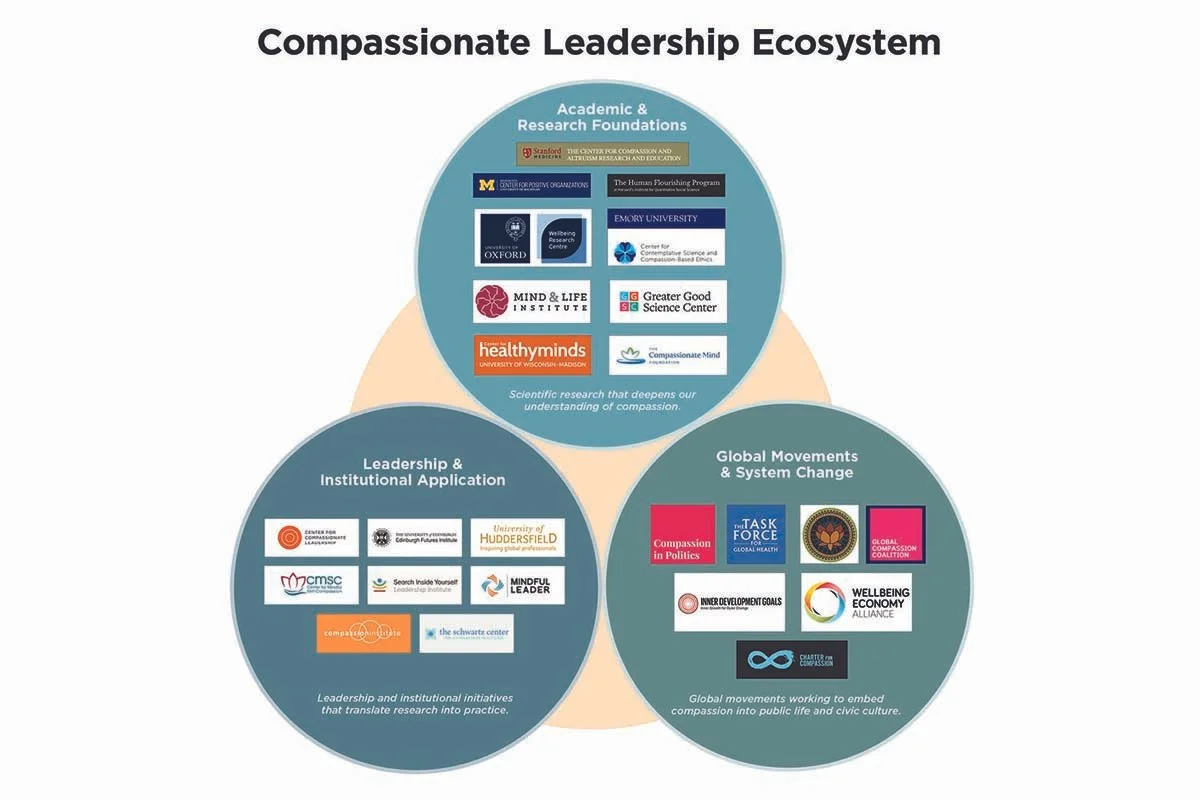
Building Compassion Into All Systems
No single person and no single organization can transform systems alone. The work of building more compassionate institutions depends on people and organizations learning from one another and acting together. What is emerging is not a single movement, but an interconnected ecosystem – one that spans disciplines, sectors, and geographies.
Together, this global ecosystem demonstrates the powerful role compassion can play in shaping institutions that are more resilient, more humane, and better able to support human flourishing in an increasingly complex world.
There are significant opportunities for each of us to find our way to engage in the growing global ecosystem for compassionate leadership. Where will you choose to engage?
Click on the linked name below to visit each organization. Scroll down or click here for a brief description of each.
9 Academic Centers Studying Compassion and Human Flourishing
Center for Positive Organizations – University of Michigan
Center for Compassion and Altruism Research and Education (CCARE) – Stanford University
Compassionate Mind Foundation
Greater Good Science Center – UC Berkeley
Center for Healthy Minds – University of Wisconsin–Madison
Human Flourishing Program at Harvard University
Wellbeing Research Centre – University of Oxford
Emory University – Center for Contemplative Science and Compassion-Based Ethics
Mind & Life Institute
8 Organizations Advancing Compassionate Leadership Through Application
Center for Compassionate Leadership
Compassion in Financial Services Hub – Edinburgh Futures Institute
Compassion Institute
Center for Mindful Self-Compassion
Schwartz Center for Compassionate Healthcare
Search Inside Yourself Leadership Institute and SIY Global
Mindful Leader
Compassionate Leadership Hub – University of Huddersfield
7 Global Movements and Networks Advancing Compassion
Compassion in Politics
Charter for Compassion
Global Compassion Coalition
Inner Development Goals Initiative
Task Force for Global Health – Focus Area for Compassion and Ethics
Wellbeing Economy Alliance
Compassionate Listening Project
Compassionate Leadership Ecosystem Organizations and Descriptions
Academic Centers Studying Compassion and Human Flourishing
Research institutions around the world are helping establish the scientific and theoretical foundations for compassion, demonstrating compassion’s impact on wellbeing, relationships, and organizational effectiveness across a growing body of interdisciplinary research. Here are nine leading organizations deepening our evidence-based understanding of compassion and leadership.
Center for Positive Organizations – University of Michigan
The Center for Positive Organizations at the University of Michigan Ross School of Business studies how organizations can become places where people and performance flourish together. From its founding in 2002 by scholars including Jane Dutton, Kim Cameron, and Robert E. Quinn, the Center has played a pioneering role in advancing research on compassion in organizational life. The center is currently led by Monica Worline, who also serves as Lead Faculty and an Advisory Board member of the Center for Compassionate Leadership. Its work explores how high-quality connections, positive leadership practices, and compassionate responses to suffering influence engagement, resilience, and performance. Through research, executive education, and partnerships with organizations and practitioners, the Center pioneered the study of compassion as a central topic within organizational scholarship. Its insights continue today to shape the leading edge of leadership development and organizational design efforts around the world.
Center for Compassion and Altruism Research and Education (CCARE) – Stanford University
The Center for Compassion and Altruism Research and Education at Stanford University studies the science of compassion and altruistic behavior. Founded by neurosurgeon James Doty, who passed away in 2025, the Center brings together neuroscientists, psychologists, and educators to explore how compassion develops and how it affects human wellbeing. Today, CCARE continues to advance scientific research on compassion and altruism. The Center investigates empathy, kindness, and prosocial behavior while also offering educational programs that translate scientific insights into everyday practice. By grounding compassion in rigorous empirical research, CCARE helps strengthen the evidence base supporting compassion as a driver of healthier individuals, stronger relationships, and more humane institutions.
Compassionate Mind Foundation
The Compassionate Mind Foundation (CMF), founded by Paul Gilbert, is a pioneering organization in the scientific and clinical study of compassion. Rooted in evolutionary psychology and neuroscience, CMF developed Compassion Focused Therapy (CFT) to support individuals struggling with shame, self-criticism, and mental health challenges. The Foundation’s work explores how compassion can be cultivated as a trainable skill, grounded in an understanding of human threat and care systems. By bridging clinical practice, research, and training, CMF contributes deep insight into the psychological and biological foundations of compassion, enriching the broader ecosystem’s understanding of how compassion can be developed and sustained.
Greater Good Science Center – UC Berkeley
The Greater Good Science Center at the University of California, Berkeley studies the science of wellbeing, compassion, and human flourishing. Founded by psychologist Dacher Keltner, the Center integrates research from psychology, neuroscience, and social science to better understand emotions such as empathy, gratitude, and compassion. Through widely read publications, online courses, and educational initiatives, the Center translates research findings into practical tools that educators, leaders, and communities can apply. By bridging scientific discovery and public understanding, the Greater Good Science Center plays an influential role in spreading compassion-informed practices across education, leadership, organizations, and community life.
Center for Healthy Minds – University of Wisconsin–Madison
The Center for Healthy Minds at the University of Wisconsin–Madison conducts research on wellbeing, resilience, and compassion through the lens of neuroscience and contemplative science. Founded by neuroscientist Richard Davidson, the Center explores how mental training practices can cultivate qualities such as kindness, emotional balance, and social connection. Its research has demonstrated that compassion and related capacities are not fixed traits but skills that can be strengthened through intentional practice. Through educational programs and collaborations with schools and organizations, the Center seeks to apply these insights to improve wellbeing at scale.
Human Flourishing Program at Harvard University
The Human Flourishing Program at Harvard University advances interdisciplinary research on the conditions that enable individuals and communities to thrive. Led by Tyler VanderWeele, the program integrates insights from psychology, economics, sociology, and public health to explore wellbeing across domains such as happiness, meaning, relationships, character, and health. While not exclusively focused on compassion, its work provides a rigorous empirical foundation for understanding how prosocial behaviors, including compassion, contribute to flourishing. Through research, convenings, and global collaborations, the program plays a vital role in grounding the broader ecosystem in evidence-based pathways to human thriving.
Wellbeing Research Centre – University of Oxford
The Wellbeing Research Centre at the University of Oxford is a leading global hub for the scientific study of wellbeing and its implications for policy and organizational performance. Directed by Jan-Emmanuel De Neve, the Centre brings together economists, psychologists, and data scientists to examine how wellbeing influences productivity, resilience, and societal progress. Its work has been particularly influential in demonstrating the measurable impact of employee wellbeing on organizational outcomes. By elevating wellbeing as a strategic priority, the Centre provides a critical evidence base that supports the integration of compassion into leadership, culture, and systems design.
Emory University – Center for Contemplative Science and Compassion-Based Ethics
The Center for Contemplative Science and Compassion-Based Ethics at Emory University integrates scientific research with contemplative traditions to explore how compassion can be cultivated and applied in modern contexts. The Center developed Cognitively-Based Compassion Training (CBCT), a secular program now used in education, healthcare, and community settings worldwide. Through research, training, and partnerships, Emory’s work demonstrates how compassion can be systematically taught and embedded into institutions.
Mind & Life Institute
The Mind & Life Institute is an interdisciplinary organization dedicated to exploring the intersection of contemplative wisdom and modern science. Established through dialogues between scientists and the Dalai Lama, the Institute has helped catalyze the field of contemplative science. Through conferences, research grants, and collaborative initiatives, Mind & Life supports scholars investigating how contemplative practices influence compassion, attention, and wellbeing. The Institute’s work has played a major role in advancing scientific understanding of compassion while fostering dialogue between ancient wisdom traditions and contemporary research.
We deeply appreciate the tireless efforts of the many researchers and staffers at these organizations who contribute to the foundational knowledge of compassionate leadership. Their work shows that compassion is measurable, trainable, actionable, and of benefit to all.
Organizations Advancing Compassionate Leadership Through Application
This second dimension of the ecosystem focuses on translating scientific insight into lived experience. It includes organizations that develop the inner capacities that make compassion sustainable, as well as those that embed compassion into leadership practice, organizational culture, and institutional systems. Together, they demonstrate that compassion is both something we can study and research and also something we can practice, strengthen, and integrate into the way organizations function.
This dimension bridges the gap between knowledge and action, showing how compassion can move from concept to capability, and from individual practice to systemic influence.
Center for Compassionate Leadership
At the Center for Compassionate Leadership, we translate the growing body of research on compassion and human flourishing into evidence-based practices that help leaders cultivate cultures rooted in safety, connection, and belonging. Through leadership and organizational training, contemplative practices, and a global community of practitioners, the Center equips leaders with the inner capacities and practical tools needed to respond to complexity with wisdom and care. Our programs emphasize both personal development and systemic change, helping leaders embed compassion into the social architecture of organizations by shaping roles, routines, networks, and culture. Participants from diverse sectors learn how compassionate leadership strengthens trust, resilience, and collaboration. By supporting leaders who can align purpose with action and influence the systems around them, the Center contributes to a growing global movement to redesign institutions so they promote human flourishing alongside organizational effectiveness.
Compassion in Financial Services Hub – Edinburgh Futures Institute
The University of Edinburgh’s Compassion in Financial Services Hub at the Edinburgh Futures Institute explores how compassion can reshape leadership and decision-making within the financial sector. Financial institutions play a powerful role in shaping economic systems and societal outcomes, yet the sector has often been criticized for prioritizing short-term financial gains over long-term societal wellbeing. The Hub brings together scholars, financial leaders, and policymakers to examine how compassion can inform more responsible financial practices and institutional cultures. Through research collaborations, leadership programs, and cross-sector dialogue, the initiative seeks to demonstrate how compassion can guide financial systems and society toward sustainability and shared prosperity.
Compassion Institute
The Compassion Institute is dedicated to cultivating compassion through evidence-based training and educational initiatives. Founded by Tibetan scholar and longtime English translator to the Dalai Lama, Thupten Jinpa, and colleagues, the Institute integrates insights from neuroscience, psychology, and contemplative traditions. Its programs help educators, leaders, and communities develop practical skills for cultivating compassion in everyday life. Through partnerships with educators, organizations, and community leaders, the Institute also works to bring compassion-based approaches into schools, workplaces, and institutions, contributing to broader cultural and systemic change.
Center for Mindful Self-Compassion
The Center for Mindful Self-Compassion (CMSC), co-founded by Kristin Neff and Christopher Germer, is dedicated to the teaching and dissemination of self-compassion practices worldwide. Through its widely adopted Mindful Self-Compassion (MSC) program, the Center equips individuals with practical tools to cultivate emotional resilience, reduce burnout, and respond to difficulty with care rather than self-criticism. Its work emphasizes that self-compassion is not self-indulgence, but a foundational capacity that enables sustainable compassion for others. Within the broader ecosystem, CMSC plays a critical role in strengthening the inner capacities that underpin compassionate leadership and relational effectiveness.
Schwartz Center for Compassionate Healthcare
The Schwartz Center for Compassionate Healthcare works to strengthen compassionate care within healthcare systems. Founded in memory of patient Ken Schwartz, the organization supports healthcare professionals in sustaining empathy and connection within demanding clinical environments. Its flagship program, Schwartz Rounds, provides structured forums where healthcare teams can reflect on the emotional dimensions of caregiving and support one another. By creating space for reflection and dialogue, the Center helps healthcare institutions maintain cultures of compassion that benefit both caregivers and patients.
Search Inside Yourself Leadership Instituteand SIY Global
The Search Inside Yourself Leadership Institute (SIYLI) and SIY Global, sister organizations with distinct audiences and delivery models originally developed at Google, bring together mindfulness, emotional intelligence, and compassion to support leadership development in organizations around the world. Their programs are grounded in neuroscience and contemplative practice, helping leaders strengthen self-awareness, resilience, and interpersonal effectiveness. By translating these insights into accessible and practical tools, they play a significant role in introducing compassion-based approaches into organizational environments. Their work demonstrates how inner development can directly enhance leadership effectiveness and organizational culture.
Mindful Leader
Mindful Leader is a community and platform dedicated to bringing mindfulness and compassion into the workplace through training, conferences, and structured opportunities for practice. It supports leaders in cultivating more present, resilient, and human-centered cultures. By bridging individual development with organizational application, Mindful Leader helps translate contemplative practices into everyday leadership behaviors and workplace norms, and in so doing seeks to cultivate mindful and compassionate work environments.
Compassionate Leadership Hub – University of Huddersfield
The Compassionate Leadership Hub at the University of Huddersfield brings together researchers, educators, and the local community to explore how compassion can transform leadership in healthcare, education, business, and public service. Located at the National Health Innovation Campus, the Hub focuses on applying compassion research to improve organizational culture, service delivery, and wellbeing in the local region. Through research projects, leadership development programs, and collaborative partnerships, the initiative seeks to support leaders in integrating compassion into institutional practices and decision-making, while strengthening the economic wellbeing of the region.
The Compassionate Leadership Hub gives us an important blueprint for how Hubs can activate the growth and development of regional economies and communities. The focus on compassionate leadership as the crucial agenda for the future brings us hope that more initiatives will follow in their footsteps to create flourishing for all.
Global Movements and Networks Advancing Compassion
Beyond research and leadership development, global networks and movements are working to bring compassion into public life, helping shape the cultural norms, civic institutions, and forms of global cooperation needed to address today’s complex challenges.
Compassion in Politics
Compassion in Politics is a movement dedicated to bringing compassion and empathy into political discourse and public decision-making. Founded in the United Kingdom, the organization works across party lines to encourage political leaders and citizens to engage in dialogue that prioritizes dignity, understanding, and the common good. Through public events, parliamentary engagement, and educational initiatives, Compassion in Politics seeks to foster a political culture in which disagreement can occur without dehumanization. By encouraging more constructive and empathetic public dialogue, the movement contributes to systemic change in democratic institutions and political culture.
Charter for Compassion
The Charter for Compassion is a global movement committed to advancing compassion as a guiding principle for communities and institutions. Inspired by the work of religious scholar Karen Armstrong, the organization connects cities, schools, businesses, and organizations that seek to embed compassion into civic life. One of its most visible initiatives, the Compassionate Cities movement, encourages communities to integrate compassion into public policy, education, and community programs. By mobilizing networks around the world, the Charter for Compassion works to foster cultures where empathy, dignity, and mutual care shape how communities address social challenges.
Global Compassion Coalition
The Global Compassion Coalition is an international alliance of organizations and leaders working to elevate compassion as a guiding value in addressing global challenges. The Coalition connects groups working across areas such as climate action, social justice, education, and human rights. Through collaborative campaigns, convenings, and shared initiatives, the network amplifies the role of compassion in shaping responses to complex global problems. By building partnerships across sectors and movements, the Coalition highlights compassion as a unifying principle capable of guiding collective action in an interconnected world.
Inner Development Goals Initiative
The Inner Development Goals (IDG) Initiative focuses on cultivating the inner capacities needed to address global challenges such as climate change, inequality, and social fragmentation. Developed as a complement to the United Nations Sustainable Development Goals, the initiative emphasizes qualities such as self-awareness, compassion, courage, and collaboration as essential to systems transformation. Through a growing global network of organizations, leaders, and practitioners, the initiative seeks to integrate inner development into leadership, education, systems, and policy. Its work highlights that solving complex global problems requires not only external solutions, but also the development of human capacities that enable wise and compassionate action.
Task Force for Global Health – Focus Area for Compassion and Ethics
The Focus Area for Compassion and Ethics at the Task Force for Global Health is dedicated to embedding compassion and ethics in global health systems. This initiative explores how compassion can guide decision-making within complex global health systems, particularly where leaders must navigate difficult ethical choices and limited resources. Through research, dialogue, and collaboration with health leaders and institutions, the initiative promotes compassion as a guiding principle in global health governance. By emphasizing the ethical dimensions of leadership and policy, it helps strengthen the human-centered foundations of international health systems.
Wellbeing Economy Alliance
The Wellbeing Economy Alliance (WEAll) is a global network of organizations, governments, and changemakers working to transform economic systems so they prioritize human and ecological wellbeing. Challenging traditional economic models that focus primarily on growth and profit, WEAll advocates for policies and practices that center dignity, sustainability, and shared prosperity. Through research, advocacy, and cross-sector collaboration, the alliance promotes a vision of an economy that supports flourishing for people and the planet. Its work represents an important shift toward embedding compassion and wellbeing into the fundamental structures that shape societal outcomes.
Compassionate Listening Project
The Compassionate Listening Project focuses on transforming conflict through deep listening and dialogue. Founded by peace activist Leah Green, the organization trains individuals and groups in practices that cultivate empathy, understanding, and nonviolent communication across deep divides. Its work has been used in polarized communities and conflict regions where dialogue is often difficult but essential. By fostering the practice of compassionate listening, the initiative helps create conditions where trust can emerge and collaborative solutions become possible.