
FLOURISHING LEADERS COMMUNITY
COMPASSIONATE LEADERSHIP RESOURCES
Welcome Front Range Community! We are delighted to share resources to support your exploration of Compassionate Leadership. Please feel free to connect with us on LinkedIn here: Evan Harrel, Laura Berland, Center for Compassionate Leadership. We’d be happy to meet online with you for any follow up questions to dive deeper into the Compassionate Leadership discussion. If you would like, please schedule time with us on our calendar here.
Presentation Slides
Click on the image below to download the slides.
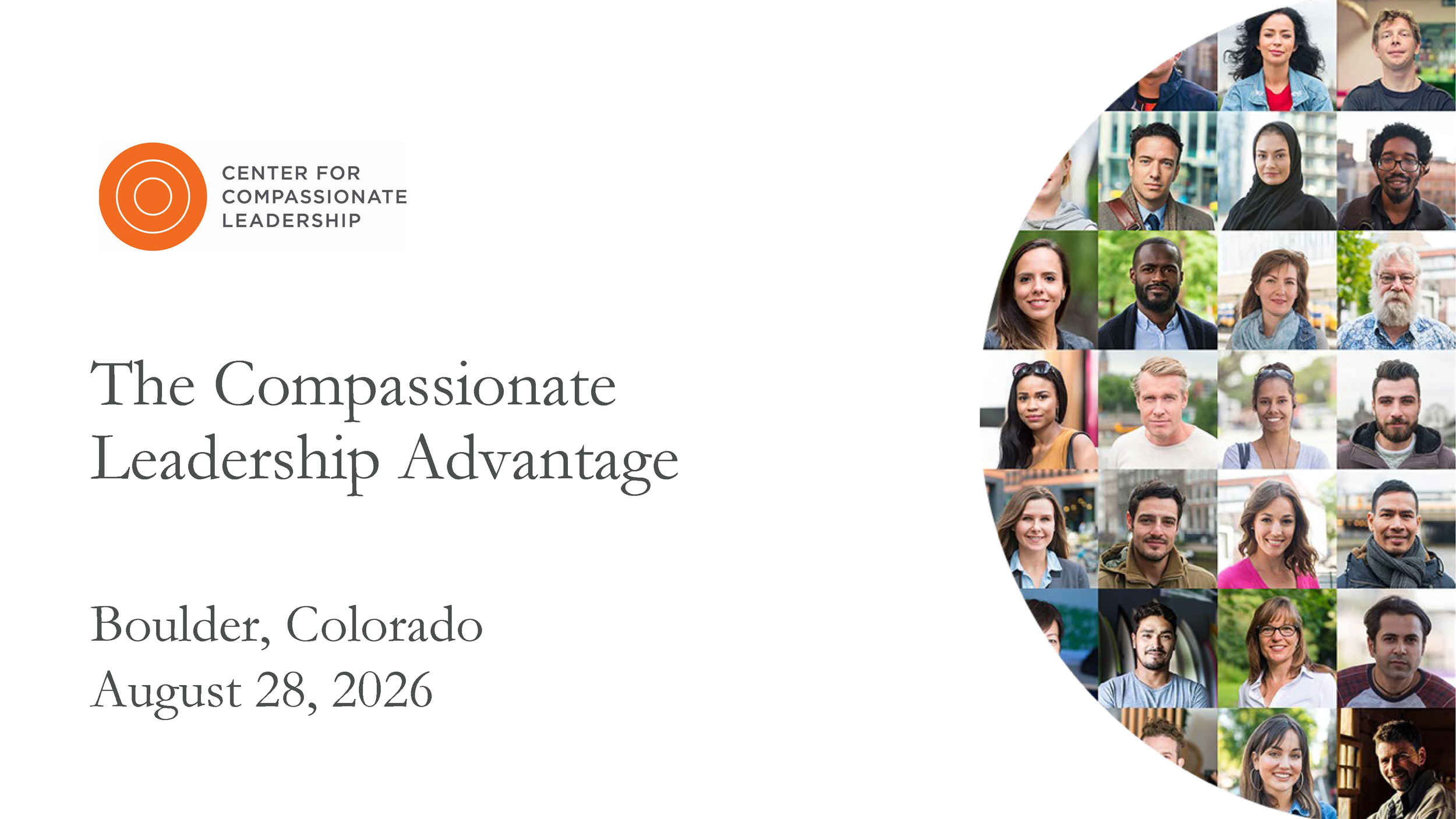
For full bibliography, scroll down or click here.
Everyday Practices
Click on the image below to download the pdf.
Practices To Support Your Compassionate Leadership
Click on the image below to download the pdf.
BIBLIOGRAPHY
The Compassionate Leadership Advantage
Boulder, Colorado – August 28, 2026
Beaumont, Elaine, et al. “Measuring Relationships between Self-Compassion, Compassion Fatigue, Burnout and Well-Being in Student Counsellors and Student Cognitive Behavioural Psychotherapists: a Quantitative Survey.” Counselling and Psychotherapy Research, vol. 16, no. 1, 2015, pp. 15–23.
Cameron, Kim, et al. “Effects of Positive Practices on Organizational Effectiveness.” The Journal of Applied Behavioral Science, vol. 47, no. 3, 2011, pp. 266–308.
Deloitte, 2018, Deloitte Insights - The Rise of the Social Enterprise: 2018 Deloitte Global Human Capital Trends.
De Neve, Jan-Emmanuel, Micah Kaats, and George Ward. "Workplace wellbeing and firm performance." (2023).
Dutton, Jane E., et al. "Explaining compassion organizing." Administrative science quarterly 51.1 (2006): 59-96.
Dutton, Jane E., Kristina M. Workman, and Ashley E. Hardin. "Compassion at work." Annu. Rev. Organ. Psychol. Organ. Behav. 1.1 (2014): 277-304.
Ferrari, Madeleine, et al. "Self-compassion moderates the perfectionism and depression link in both adolescence and adulthood." PloS one 13.2 (2018): e0192022.
Fowler, J. H., & Christakis, N. A. (2010). Cooperative behavior cascades in human social networks. Proceedings of the National Academy of Sciences, 107(12), 5334-5338.
Klimecki, Olga M., et al. “Functional Neural Plasticity and Associated Changes in Positive Affect After Compassion Training.” Cerebral Cortex, vol. 23, no. 7, 2012, pp. 1552–1561.
Konrath, Sara, et al. "Motives for volunteering are associated with mortality risk in older adults." Health Psychology 31.1 (2012): 87.
Lilius, Jacoba M., et al. “The Contours and Consequences of Compassion at Work.” Journal of Organizational Behavior, vol. 29, no. 2, 2008, pp. 193–218., doi:10.1002/job.508.
Mann, Annamarie, and Jim Harter. Gallup, 2016, The Worldwide Employee Engagement Crisis.
Neff, Kristin. “The Five Myths of Self-Compassion.” Greater Good Magazine, 30 Sept. 2015, greatergood.berkeley.edu/article/item/the_five_myths_of_self_compassion.
Neff, Kristin. Self Compassion. William Morrow, 2011.
Rose, Todd. Collective illusions: conformity, complicity, and the science of why we make bad decisions. Grand Central Publishing, 2022.
Singer T, and Klimecki OM. “Empathy and compassion.” Current Biology 24(18), 2014: R875-R878
Steinhausen, Simone, et al. “Short- and Long-Term Subjective Medical Treatment Outcome of Trauma Surgery Patients: the Importance of Physician Empathy.” Patient Preference and Adherence, 2014, p. 1239.
Weng, Helen Y., et al. “Compassion Training Alters Altruism and Neural Responses to Suffering.” Psychological Science, vol. 24, no. 7, 2013, pp. 1171–1180.
Wilkinson, Helen, et al. “Examining the Relationship between Burnout and Empathy in Healthcare Professionals: A Systematic Review.” Burnout Research, vol. 6, 2017, pp. 18–29.
Worline, Monica C., and Jane E. Dutton. Awakening Compassion at Work: The Quiet Power That Elevates People and Organizations. Berrett-Koehler Publishers, 2017.
Zolnierek, Kelly B. Haskard, and M Robin Dimatteo. “Physician Communication and Patient Adherence to Treatment.” Medical Care, vol. 47, no. 8, 2009, pp. 826–834.