


Compassionate Leadership in the Age of AI, Part 2: Building Organizations That Care
Compassion remains a uniquely human capacity. Yet AI can help leaders build organizations that are better equipped to cultivate compassion. By strengthening roles, routines, and networks, AI can help organizations notice suffering, foster connection, and create conditions where people and organizations thrive together.

Compassionate Leadership in the Age of AI: The Playbook for Human-Centered Organizations
AI is not the strategy. It is a tool. Leaders must decide what kind of organizations they want to architect, then determine how AI can support that vision. Compassionate leadership is the playbook for the AI era, helping organizations use technology intentionally to become more deeply human.

Teams: The Ideal Place to Grow Compassionate Leadership
Teams are the ideal place to grow compassionate leadership. This is where many of our most important human interactions at work occur, and where our ability to shape culture is amplified by the human scale of teams. Within teams, leading with compassion and leading for compassion reinforce one another in tangible, everyday ways, making teams the ideal place for compassionate leadership to take shape in practice.
The Growing Global Ecosystem for Compassionate Leadership - Part 3
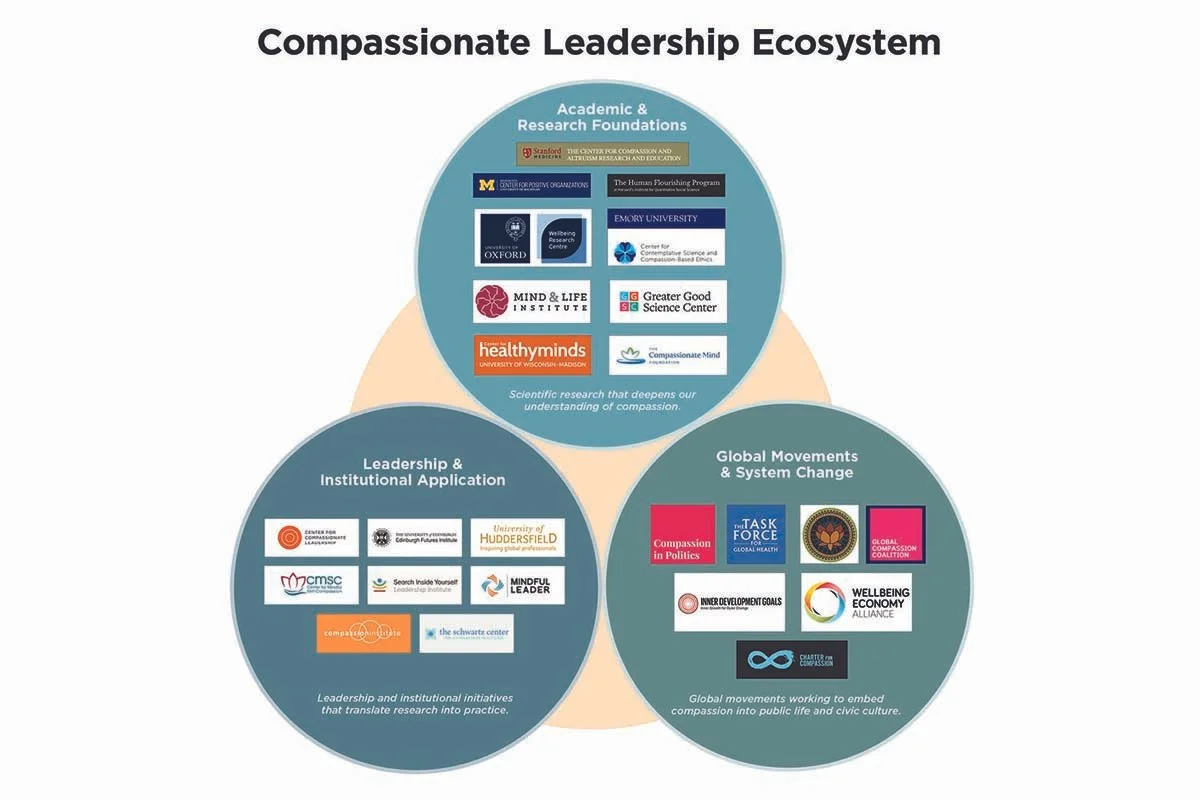
In this final article, we explore the dimension of the compassionate leadership ecosystem focused on systems change. These global movements and networks are working to embed compassion into public life – shaping culture, policy, and economic systems, and demonstrating how compassion can serve as an organizing principle for more humane and resilient societies.

The Growing Global Ecosystem for Compassionate Leadership – Part 2
In this second article in our series on the compassionate leadership ecosystem, we explore organizations that are translating compassion from research into practice. These organizations cultivate both individual and systemic capacities that sustain compassion and embed it into leadership, culture, and institutions to create flourishing workforces and thriving organizations.

The Growing Global Ecosystem for Compassionate Leadership – Part 1
Across the globe, a growing body of research is deepening our understanding of compassion and its role in human and organizational flourishing. In this first article in a three-part series, we highlight the academic institutions building the scientific foundation for compassionate leadership, demonstrating that compassion is measurable, trainable, actionable, and of benefit to all.

Compassionate Action: Moving from Resonance to Response
Compassion calls us forward into action. After noticing suffering, interpreting generously, and cultivating empathy, the final step is allowing care to take form in wise, courageous response. Compassionate action may not always fix what hurts, but it brings discernment and intention to what is possible. When we do this, we begin to reshape the systems around us. (This is the fourth in our four-part series on compassion.)

Empathy: Resonance, Not Rescue
Empathy is the capacity to resonate with another’s suffering. When we rush to fix, we bypass that resonance; when we remain stuck in it, we cannot move to compassion. Compassionate leaders engage this uniquely human capacity with discernment and boundaries, enabling wise, sustainable compassionate action.

Interpreting Generously: Seeing Our Shared Humanity
Interpreting generously is the second step in the four-step process of compassion. When we notice suffering, we immediately begin making meaning. Compassionate leaders slow down, recognize shared humanity, and resist blame or distance, creating conditions for wiser, compassionate responses at work. (This is the second in our four-part series on The Elements of Compassion)

The First Element of Compassion: Noticing
Compassion begins with noticing. In a time of rising pressure and fatigue, leaders can often turn away from difficulty or get overwhelmed by it. There is a third way: steady presence. By noticing early signals, creating psychological safety, and seeing clearly without rushing to fix, leaders reduce anxiety, prevent escalation, and lay the groundwork for wise, compassionate action. It is the first in our four-part series on compassion.